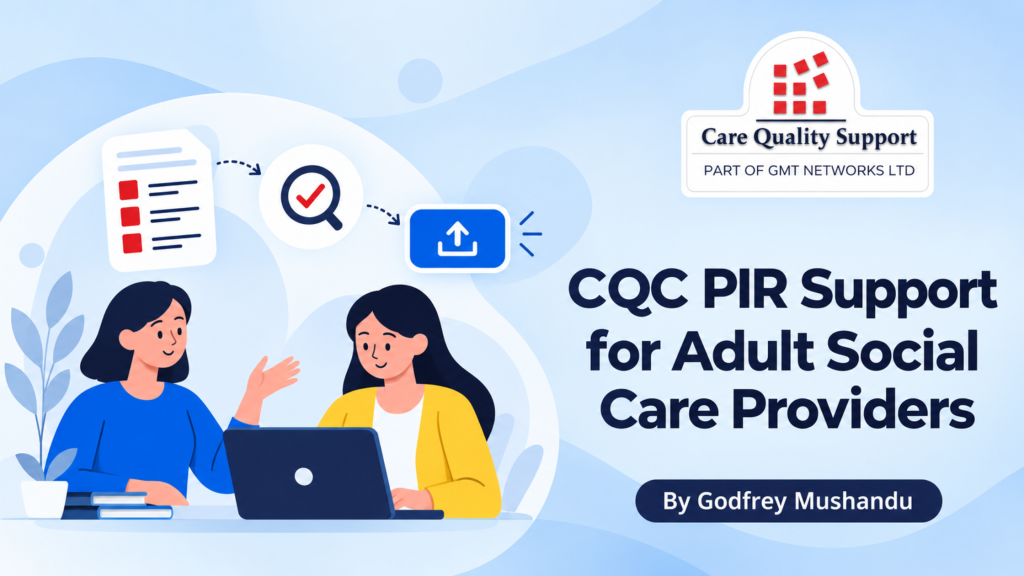
For busy registered managers and care providers, completing the Care Quality Commission (CQC) Provider Information Return (PIR) can feel like another major task alongside staffing, safeguarding, incidents and day-to-day service delivery. However, effective CQC PIR support can turn the return into a useful account of how your service performs, learns and improves.
The PIR is more than an administrative form. It gives the CQC information about your service, what is working well, the barriers you face and the systems you use to maintain quality. Clear, accurate responses help CQC understand your service between assessments and identify areas that may need closer attention.
What is the CQC PIR
The Provider Information Return, commonly called the PIR, is an online return used by CQC to collect information about adult social care services. It is required under Regulation 17(3) of the Health and Social Care Act 2008 (Regulated Activities) Regulations 2014. Providers must complete it once each calendar year. The registered manager normally receives an email containing a unique link and has four weeks to submit the return. The nominated individual is notified, but does not receive a separate completion link unless they are also the registered manager.
The questions vary according to the service type. For adult social care community services, CQC may ask about:
- successes and barriers to providing good care
- the people who use the service
- staffing, training and qualifications
- commissioners and partnership working
- quality assurance and risk management
- complaints and incidents
- digital social care records
- service-specific operational information.
For example, a domiciliary care agency may need to provide figures on care visits, missed visits, visits requiring more than one care worker and personal-care hours delivered. Therefore, providers should check the current question guidance for their own service type before preparing answers.
Why clear PIR responses matter
A strong PIR response does not try to present a flawless organisation. Instead, it gives an honest, clear and evidence-based picture of the service. It explains what the provider does, how leaders check that it works and what difference it makes to people.
For instance, the statement “We provide good staff training” gives CQC very little useful information. A stronger response would identify the relevant training, explain how managers assess competence and describe an outcome for people using the service. This approach connects activity, evidence and impact.
Where relevant, structure each response around the following points:
- What do we do?
- How do we monitor it?
- What evidence do we hold?
- What did we learn?
- What action did we take?
- What difference did the action make?
This structure helps the reader understand how governance operates in practice. It also reduces vague claims and keeps the answer focused on outcomes rather than policies alone.
Prepare your evidence before completing the PIR
Do not try to complete the return from memory. First, gather current information from across the service and confirm the reporting periods used in each question. Depending on your service, you may need:
- staff numbers, vacancies and turnover figures
- training, competency and qualification records
- supervision and appraisal information
- complaint, incident and safeguarding records
- quality audits and improvement plans
- feedback from people, relatives and staff
- commissioner and partnership information
- care-delivery statistics
- anonymised examples of positive outcomes
- evidence of changes made after feedback, incidents or audits.
Check all figures against source records before using them. In addition, agree who will contribute information and who will complete the final review. Although colleagues may help draft sections, the registered manager should retain oversight of the completed return.
How CQC PIR support strengthens your answers
A common difficulty is deciding how much detail to provide. CQC asks providers to keep free-text responses concise and clear, use anonymised evidence and stay within any stated word limit. Some answers are limited to 500 words, so every sentence should add useful information.
Compare these two approaches:
Basic response: “We conduct regular quality audits.”
Stronger response: “Managers complete monthly audits across key areas of service delivery. They record findings, assign actions and monitor completion. A recent audit identified gaps in recording, which led to additional staff guidance and follow-up competency checks. The next audit showed improved compliance.”
The stronger version describes the process, oversight, action and result. Consequently, it gives CQC a clearer view of how the provider identifies and manages risk.
Be honest about barriers and improvement
Providers sometimes worry that mentioning challenges will automatically reflect badly on the service. However, CQC specifically asks about barriers to good care, their effect and the action being taken. Avoid minimising a genuine problem or making unsupported assurances.
A useful structure is:
- Challenge: What is making good care harder to deliver?
- Impact: How does it affect people, staff or the service?
- Action: What have you done or planned?
- Monitoring: How are you checking progress?
- Progress: What has improved and what still needs attention?
For example, if recruitment has been difficult, explain the effect on capacity and continuity. Then describe the controls in place, such as safer recruitment activity, revised rotas, agency oversight or limits on accepting new packages. Honest responses supported by action show that leaders understand their risks.
Common CQC PIR mistakes to avoid
- Incomplete mandatory answers. Review every section and complete all required fields before submission.
- Unsupported statements. Replace broad claims with specific, relevant evidence.
- Too much process and too little impact. Explain how actions affect people receiving care.
- Identifiable personal information. Remove names and details that could identify individuals.
- Inconsistent figures. Check that numbers agree with rotas, records and other submitted data.
- Outdated examples. Use current evidence that reflects how the service now operates.
- Leaving the work until the deadline. Allow time to collect data, review answers and resolve gaps.
Also follow the form instructions carefully. Complete questions in the correct order, use the form’s navigation controls and avoid opening the return on several computers at the same time. These practical steps reduce the risk of missed questions or lost information.
Draft and review your responses separately
CQC advises providers to prepare responses in a separate document and copy them into the online form. This protects your working draft if information does not save correctly and makes internal review easier.
Drafting separately allows you to:
- review grammar, clarity and word limits
- verify statistics and reporting periods
- obtain input from relevant colleagues
- remove personal or identifying information
- check examples against available evidence
- retain a working record of the submitted answers.
Before submission, read the return as one document. Check that answers do not contradict each other and that commitments match the provider’s actual systems and improvement plans.
Make PIR preparation part of ongoing governance
The best preparation happens throughout the year. Regular oversight of complaints, incidents, audits, staffing, training, feedback and improvement actions gives leaders reliable information when the PIR arrives.
Your governance systems should make it easy to answer four questions:
- What is working well?
- Where are the risks or gaps?
- What action has been taken?
- Has that action improved outcomes?
When providers maintain this information consistently, the return reflects real service governance rather than a rushed exercise. It also supports wider inspection readiness because managers can explain their evidence, learning and progress at any time.
How Care Quality Support can assist
Care Quality Support provides practical CQC PIR support for adult social care providers. We help organisations organise their evidence, understand individual questions and develop clear responses that reflect their own practice.
Our support can help you:
- interpret what each PIR question is asking
- identify and organise the information required
- develop clear, structured and evidence-based answers
- strengthen the connection between actions and outcomes
- review responses for clarity, consistency and completeness
- identify gaps that need further evidence or internal action.
Our role is to help you present an accurate picture of your service. The provider remains responsible for ensuring that every statement submitted to CQC is complete, accurate and truthful.
Prepare your CQC PIR with confidence
If your Provider Information Return is pending, start by bringing the relevant records together and assigning enough time for review. Good CQC PIR support should make the process clearer, but it should never replace the provider’s own evidence, oversight or accountability.
Do not leave an important regulatory return until the last minute. Speak to Care Quality Support for structured assistance with preparing or reviewing your PIR responses.
Telephone: 0208 064 2464
WhatsApp: +44 7918 295291
Email: admin@carequalitysupport.co.uk
Website: carequalitysupport.co.uk