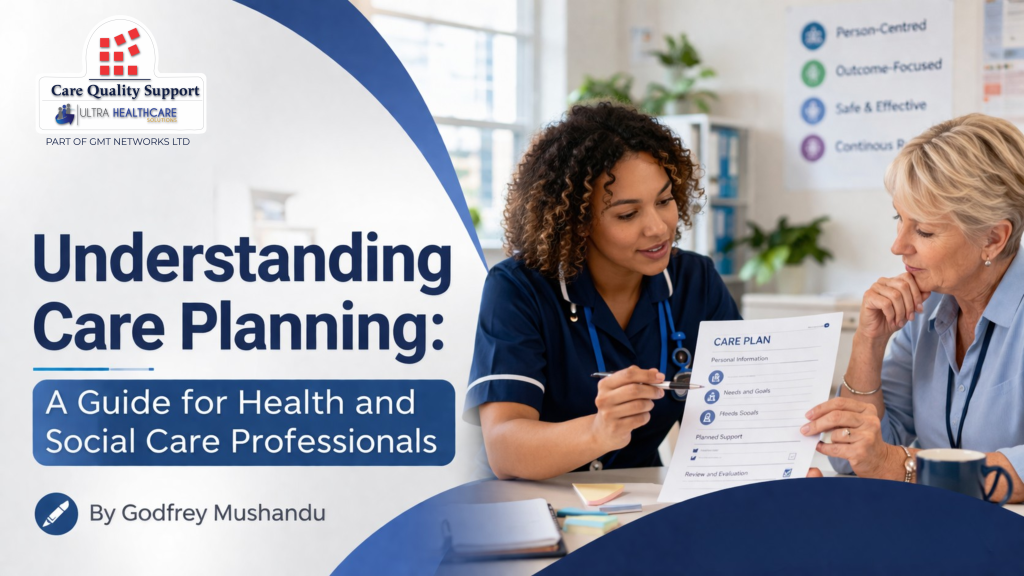
Understanding care planning in health and social care is essential for any provider aiming to deliver high-quality, person-centred support. This article explores understanding care planning in health and social care and explains how it shapes outcomes, compliance, and lived experience within services.
Care planning is not an administrative task. Instead, it is the most important clinical and operational document in any service. It directly influences a person’s safety, dignity, and quality of life. When done well, it supports outstanding practice. However, when done poorly, it quickly becomes evidence of failure during inspection.
Over time, many providers focus too much on documentation and not enough on meaning. Yet, the difference between good and outstanding services lies in how care plans are created, reviewed, and used in daily practice. Therefore, understanding care planning in health and social care is not optional—it is fundamental.
What is a care plan and why understanding care planning matters
A care plan is a legally significant document. It connects directly to key legislation, including:
- health and social care act 2008 (regulated activities) regulations 2014
- care act 2014
- mental capacity act 2005
It is not a form to complete. Instead, it is a living, evolving record of a person’s:
- needs
- wishes
- risks
- agreed support
Most importantly, it must be created with the person, not for them.
Regulation 9 clearly states that care must:
- be appropriate
- meet individual needs
- reflect personal preferences
Because of this, care planning becomes the foundation of both compliance and quality. In addition, inspectors often use care plans as the first piece of evidence during inspections.
Understanding care planning under the CQC framework
Understanding care planning in health and social care requires a clear understanding of the CQC single assessment framework (SAF). Since its introduction, expectations have changed significantly.
Previously, inspectors focused on documentation. Now, they focus on lived experience. In other words, they want to see how care plans translate into real care.
Care planning links directly to:
- responding to people’s immediate needs
- personalised care, treatment and support
These areas sit across all key questions:
- safe
- effective
- caring
- responsive
- well-led
As a result, inspectors look for clear and consistent evidence. They expect to see:
- genuine involvement from the person
- alignment between care plans and staff practice
- clear updates when needs change
- use of the person’s own voice
- enabling risk management
- collaboration with professionals
- regular and meaningful reviews
Therefore, understanding care planning means focusing on outcomes, not just documentation.
The seven pillars of understanding care planning in health and social care
To fully understand care planning in health and social care, providers must focus on the core elements that define outstanding practice. These seven pillars form the foundation.
1. comprehensive assessment
A strong assessment should include:
- physical health
- emotional wellbeing
- social background
- cultural and spiritual needs
It should tell the person’s story clearly.
2. collaborative goals
Goals should be:
- agreed with the individual
- meaningful to their life
- supported by family or advocates
This ensures care remains person-centred.
3. detailed interventions
Care plans must clearly outline:
- who provides care
- what support is needed
- when support is delivered
- how it should be done
Clarity improves consistency and safety.
4. risk management
Risk management should:
- support independence
- balance safety and choice
- avoid unnecessary restrictions
5. MCA compliance
Care plans must include:
- capacity assessments
- best interests decisions
- clear documentation
- DoLS applications where required
6. review cycles
Reviews should be:
- regular
- responsive to change
- clearly documented
For example, new needs should be reviewed within 28 days.
7. lived experience evidence
Care plans should reflect:
- the person’s voice
- their preferences
- their feedback
Together, these pillars define outstanding care planning.
Person-centred language in understanding care planning
Language plays a critical role in understanding care planning in health and social care. The way a care plan is written affects how care is delivered.
Outstanding services use first-person language. For example:
- “i like to have my shower in the morning”
- “i prefer to choose my clothes each day”
In contrast, third-person language feels distant and less effective.
Using first-person language:
- humanises the care plan
- improves clarity for staff
- strengthens inspection evidence
Moreover, it shows clear involvement from the individual. Therefore, providers should prioritise this approach.
Risk assessment and enabling independence
Risk assessment is often misunderstood. Many providers take a cautious approach. However, this can restrict individuals unnecessarily.
Understanding care planning means supporting independence while managing risk.
An effective risk assessment should:
- identify the risk clearly
- explain the context
- include the person’s views
- balance safety and choice
- outline proportionate controls
- reference relevant legislation
- be reviewed regularly
Importantly, overly restrictive practices may breach legal rights. Therefore, a balanced approach is essential.
Common mistakes in care planning and how to avoid them
Even experienced providers make mistakes. Understanding care planning includes recognising these common issues.
common failures include:
- generic care plans that lack detail
- outdated information that does not reflect current needs
- inconsistencies between care plans and risk assessments
- missing evidence of involvement
- gaps in mental capacity act compliance
To improve, providers should:
- prioritise quality over speed
- review care plans regularly
- train staff effectively
- audit documentation consistently
As a result, services can improve both care quality and inspection outcomes.
Understanding care planning across different care settings
Care planning varies across settings. However, the core principles remain consistent.
domiciliary care
Care plans must:
- guide staff unfamiliar with the person
- reflect the home environment
- include family involvement
supported living
Care plans should:
- align with tenancy agreements
- include multidisciplinary input
- support independence
end-of-life care
Care plans must include:
- advance care planning
- DNACPR decisions
- preferred priorities for care
Each setting requires a tailored approach. However, understanding care planning ensures consistency across all services.
Care planning as a governance tool
Care planning is not only a frontline task. It is also a key governance tool. Strong organisations use care plans to monitor and improve quality.
A robust system should include:
- regular care plan audits
- senior management oversight
- clear escalation processes
- staff sign-off and understanding
- integration into quality assurance frameworks
- service user feedback systems
In addition, governance ensures accountability. It also supports continuous improvement.
The difference between good and outstanding care planning
The difference between good and outstanding care planning is clear. Good services complete care plans. Outstanding services live them.
Outstanding providers:
- treat care planning as an ongoing process
- involve individuals continuously
- adapt plans as needs change
- focus on real experiences
Consequently, care plans evolve alongside the person. Inspectors can easily see this in practice.
Conclusion: why understanding care planning in health and social care is essential
Understanding care planning in health and social care is critical for delivering high-quality support. It is not just about compliance. It is about people.
Care planning, when done well, becomes:
- a clinical tool
- inspection evidence
- a reflection of organisational values
Good is not the goal. Outstanding is the standard.
Ultimately, understanding care planning means understanding the individual. If the care plan does not reflect the real person, it is not good enough.
That is the standard. Providers must aim to meet it and then exceed it.
Please do not hesitate to contact us for further clarification.
Managing Director
Care Quality Support and Ultra Healthcare
Registered Address: 20-22, Wenlock Road, London, N1 7GU, England.
Operational Office: Astral Towers, 4th Floor, Betts Way Crawley, RH10 9XA
Email: godfrey@carequalitysupport.co.uk
Web 1: https://www.carequalitysupport.co.uk/
Web 2: https://www.ultrahealthcare.co.uk
Phone: 020 8064 2464 WhatsApp: +447737144708
📞 Admin Contact for Additional Support: Email: admin@carequalitysupport.co.uk Phone: 02080642464 Website: Care Quality Support WhatsApp: +447737144708