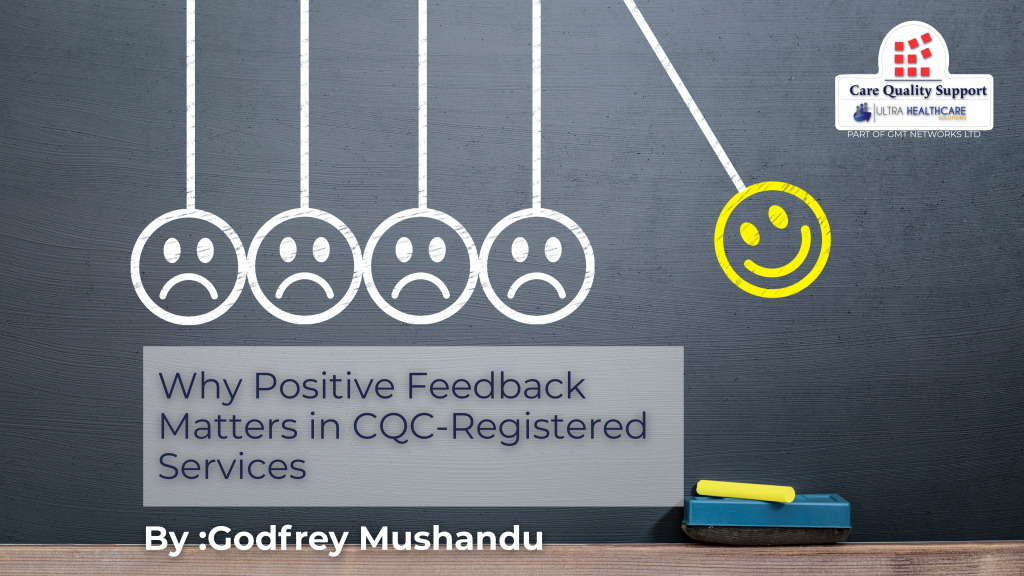
Positive feedback matters in CQC (Care Quality Commission) and when it is missing, the impact on service quality is both real and measurable. Imagine a care worker who spends forty minutes patiently supporting a resident through a painful physiotherapy routine, all the while offering quiet encouragement and a warm cup of tea afterwards. The resident feels genuinely cared for. The family notices the difference. Yet not a single word is recorded, shared, or celebrated.
A week later, a minor medication labelling error generates three written reports, a management review, and a staff meeting. Both events happened. Only one was heard.
Understanding the imbalance in feedback across CQC services
For CQC-registered services, whether domiciliary care agencies, supported living providers, or residential care homes, feedback is not simply a performance management tool. It is the lifeblood of continuous improvement, the mechanism by which services understand what genuinely works for the people they support and the evidence base that underpins outstanding care. Yet there is a persistent and largely unacknowledged imbalance in the feedback most services receive: we hear abundantly about what went wrong, and far too seldom about what went brilliantly right.
- Feedback should drive improvement, not just performance management.
- It helps identify what genuinely works in practice.
- However, far more attention is given to what goes wrong than what goes right.
This raises a question worth sitting with: in a sector that speaks regularly about person-centred values, dignity, and respect, why do we so rarely extend those same values to the act of recognising excellence when we encounter it?
Why positive feedback matters in CQC services
Feedback performs two essential and complementary functions in regulated health and social care.
Negative feedback, including complaints, concerns and safeguarding referrals, plays a non-negotiable role in identifying harm, protecting vulnerable people, and triggering remedial action.
However, positive feedback serves an equally vital purpose. It tells services:
- What to protect
- What to invest in
- What to replicate
- What outstanding care looks like in practice
When a service learns that a particular approach to meal planning improves wellbeing, or that a consistent keyworker model reduces anxiety, that knowledge has operational value.
| “CQC’s Single Assessment Framework places considerable weight on the experiences of people who use services. Those experiences include the positive ones and silence is not the same as satisfaction.” |
Positive feedback matters in CQC because continuous improvement depends on understanding both success and failure.
The negativity bias
Psychologists describe a tendency to focus more on negative experiences than positive ones. In CQC-regulated services, this is amplified.
When care goes wrong:
- Risk is high
- Documentation is required
- Action is immediate
Where care goes well:
- It is seen as expected
- It is rarely recorded
- It often goes unnoticed
There are at least three further reasons why positive feedback remains scarce:
- There is a cultural assumption that good care is the baseline, not the achievement and that thanking a care worker for doing their job competently feels unnecessary or even patronising.
- Many services have not made it genuinely easy to share positive observations: complaints procedures are prominent and well-signposted, whilst feedback forms for positive comments are an afterthought, if they exist at all.
- Some people, families, commissioners, and even service users themselves, worry that expressing praise may be perceived as naïve, or that it will somehow dilute or complicate any concerns they may wish to raise in future.
The impact of silence when positive feedback matters in CQC
Consider this:
A domiciliary care coordinator develops an innovative method for supporting clients with complex anxieties during personal care routines, reducing distress markedly across a caseload. No one formally records it. The coordinator leaves the organisation. The method is lost entirely. Meanwhile, a neighbouring provider struggles with the same challenge and finds no guidance. Both services are CQC-registered. Both experienced this as a quality issue. Only one, inadvertently, had the answer.
The absence of positive feedback creates real and measurable harm to service quality:
- They begin to operate from risk and anxiety, not confidence.
- Staff become more susceptible to burnout and disengagement.
- The motivational cost of silence is not trivial.
- Managers cannot champion what they cannot see.
- Inspectors cannot evidence what has never been recorded.
- Services develop a skewed view of their own performance.
Encouraging a balanced view
Redressing this imbalance is neither complicated nor costly. What it requires is intentionality: a deliberate decision by service leaders to treat positive feedback as professionally important, worth seeking, worth capturing, and worth acting upon.
- Make it effortless. Alongside complaints procedures, provide simple, accessible channels for positive feedback, a brief digital survey, a suggestions and commendations book, or a clearly labelled section on a service’s website.
- Ask directly. During supervisions and reviews, ask:
- “What did we do well this week?”
- “Is there anything that has felt particularly helpful recently?”
- Celebrate publicly and purposefully. Share commendations in team meetings, newsletters, and supervision records. Name the individual or team and describe the behaviour praised.
- Train staff to receive feedback well. Many care workers are uncomfortable receiving praise. Training ensures that good practice is acknowledged and recorded.
- Include positive feedback in governance structures. Quality assurance meetings and audits should include analysis of positive feedback alongside complaints data.
Conclusion: positive feedback matters in cqc
A healthy feedback ecosystem in any CQC-registered service is not one where concerns are suppressed, quite the contrary. It is one where concerns are heard, acted upon, and documented, and where achievements are recognised with equal rigour.
Both forms of feedback are evidence, drive improvement and both reflect the reality of what is actually happening for the people a service exists to support.
The silent compliment, the appreciation never shared, the success never recorded and the excellence never celebrated costs nothing in the moment and everything over time. It drains staff morale, erodes organisational learning and leaves inspectors without the evidence base to recognise genuinely outstanding provision.
The call to action is straightforward: the next time you witness exceptional care;
- write it down
- share it
- name it
- tell the person who delivered it
- tell their manager
- tell their organisation.
In doing so, you are not simply being kind. You are actively contributing to a culture of excellence.