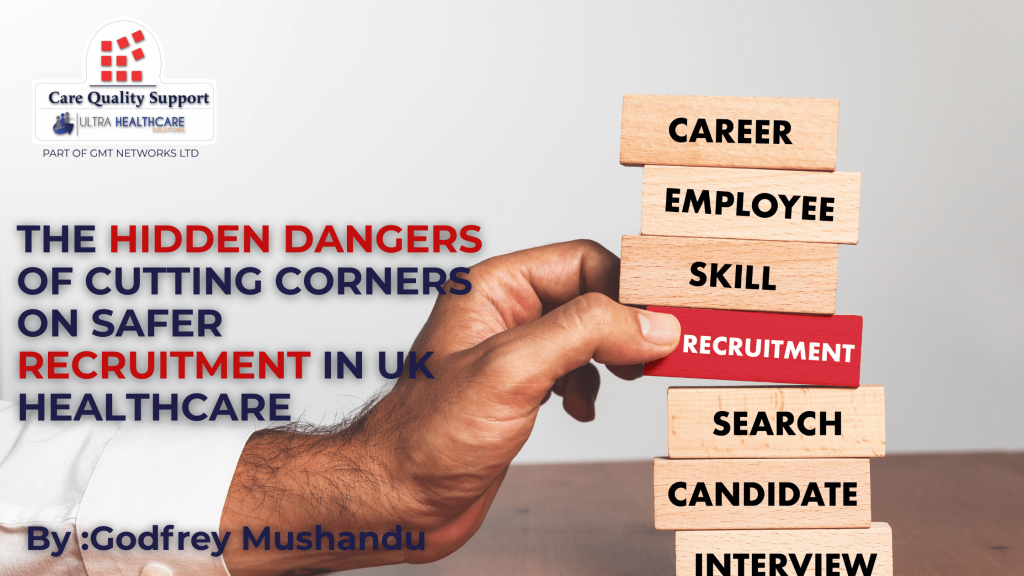
Why the Dangers of cutting corners on safer recruitment can destroy your organisation
Having worked in UK healthcare for years, I have seen firsthand the dangers of cutting corners on safer recruitment. Too many providers learn the hard way that “safer recruitment” is far more than a box-ticking exercise, it is the firewall that protects your service users from harm.
The Care Quality Commission (CQC), National Health Service (NHS) Employment Check Standards and the Disclosure and Barring Service (DBS) do not write these rules for fun. They exist because real people have been abused, neglected or harmed by staff who should never have been allowed near a vulnerable person.
If you are a General Practice owner, care home manager, private clinic director or HR lead in an NHS trust, this one is for you.
What happens when safer recruitment fails?
The brutal reality in plain English:
- CQC can shut you down: A breach of Regulation 19 (“Fit and Proper Persons Employed”) can land you in “Inadequate” or “Special Measures”. I have seen services banned from recruiting until they fix their processes. In extreme cases, registration is cancelled. Game over!
- Unlimited fines and criminal prosecution: Knowingly, or even carelessly, employing someone who is on the barred list is a criminal offence under the Safeguarding Vulnerable Groups Act 2006. Penalties can reach tens or even hundreds of thousands of pounds and in the most serious cases, individuals can face imprisonment.
- Massive compensation claims: If an unsuitable employee harms a service user because you skipped references or DBS checks, you are vicariously liable. Compensation in abuse or neglect cases often reaches six-figure sums and if hiring was negligent, your insurance may not cover it.
- Reputational annihilation: A public CQC report highlighting poor recruitment practices spreads quickly. Patients may leave, referrals can dry up and talented staff may avoid your service. Meanwhile, social media and local press often amplify these stories.
- Personal consequences for directors and managers: Under the Fit and Proper Persons Requirement (FPPR), directors can be disqualified from holding such roles anywhere in health and social care. Careers can end overnight.
Real-world examples of the dangers of cutting corners on safer recruitment:
Every single one involved recruitment failures.
- Winterbourne View
- Orchid View
- Mid-Staffordshire NHS Foundation Trust Scandal-The Robert Francis Inquiry
- Multiple NHS trust scandals where staff with concerning histories slipped through the net.
What does “doing it right” actually look like?
It’s not rocket science, but it has to be consistent:
- Full employment history with gaps explained
- Minimum two references (one from most recent employer)
- Enhanced DBS with barred list check (and renewals every 3 years)
- Professional registration checks (GMC/NMC/HCPC) on the day of starting
- Right-to-work and identity verification
- Health assessment
- Documented risk assessment if anything flags up
Keep the evidence forever.
The good news? Getting recruitment right protects service users and patients, gives you peace of mind and saves money over time through reduced agency costs, lower staff turnover and cheaper insurance.
Final thought
Cutting corners on recruitment to save a few days or pounds is like not fastening your seatbelt to save 10 seconds. It only takes one mistake to cause disaster. It only has to go wrong once!
If you are responsible for hiring in UK healthcare, treat safer recruitment as non-negotiable. Your service users, patients and even your future self will thank you for it.