Context and why this matters
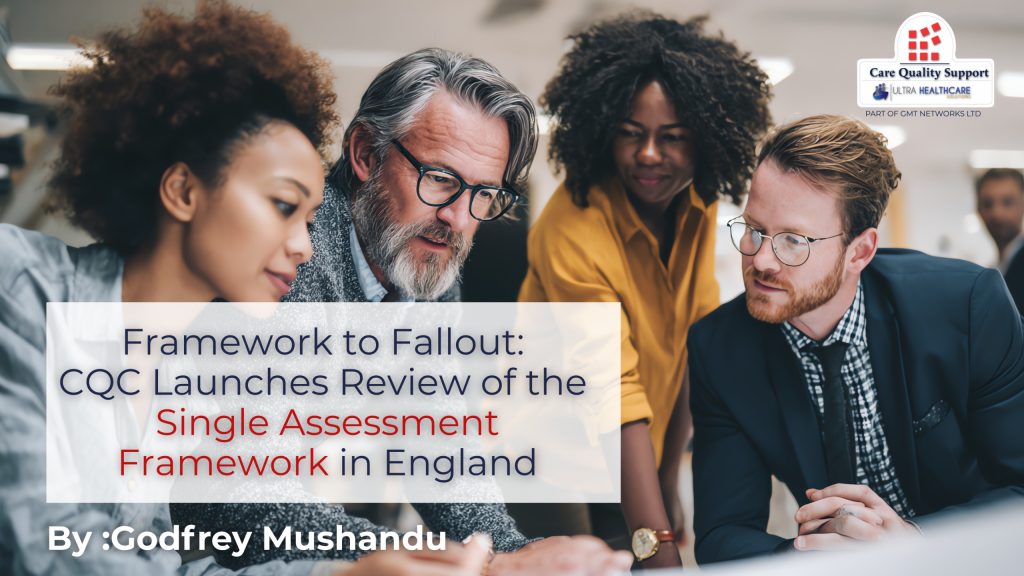
The Care Quality Commission (CQC) has formally announced a review of the Single Assessment Framework in England, following sustained and widespread feedback from across the health and social care sector.
Since its introduction, providers, registered managers, investors and commissioners have raised serious concerns about the framework’s implementation. These concerns include inconsistent application, operational failure, limited transparency and prolonged delays in inspection outcomes and ratings. In many cases, regulatory decisions have taken so long that they have directly affected business viability, commissioning confidence and workforce stability.
The review is therefore significant. It does not simply affect how providers are inspected; it influences investment decisions, service sustainability, local authority placements and, ultimately, the experiences of people who use services.
What the review of the Single Assessment Framework was meant to achieve
The Single Assessment Framework was designed to modernise regulation and move CQC away from rigid, cyclical inspection models. Its stated objectives were ambitious and, in principle, well intentioned.
The framework aimed to:
- Introduce a flexible, risk-based approach to regulation
- Replace fixed inspection cycles with ongoing assessment
- Use multiple evidence categories and Quality Statements aligned to the five key questions:
- Safe
- Effective
- Caring
- Responsive
- Well-led
In doing so, the CQC intended to improve the timeliness of inspections, the accuracy of ratings, and the use of data and intelligence to identify risk and drive improvement.
Conceptually, the Single Assessment Framework sought to reflect how services actually operate, continuously, not episodically, and to use intelligence more intelligently.
Where the framework fell apart in practice
Despite its intentions, the Single Assessment Framework has struggled in real-world delivery in the following ways.
1. Delayed inspections and ratings
One of the most damaging outcomes has been delay. Many providers report waiting 12 to 24 months for ratings following inspections. These delays have had tangible consequences, including lost tenders, paused placements, weakened cash flow and declining staff morale.
For new providers and growing organisations, the absence of a rating has often meant exclusion from commissioning opportunities altogether.
2. Inconsistent inspector interpretation
The same evidence has frequently produced different outcomes depending on geography or inspection teams. Quality Statements, particularly under Well-led, have been applied unevenly, creating uncertainty about expectations and standards.
This inconsistency has undermined confidence in the fairness and reliability of regulatory judgments.
3. Poor evidence handling
Providers have reported that evidence submitted through the Provider Portal has not always been reviewed or acknowledged. In contrast, significant weight has sometimes been given to third-party intelligence without sufficient triangulation or context.
This imbalance has contributed to perceptions that evidence handling is opaque and, at times, arbitrary.
4. Lack of procedural fairness
Many providers have struggled to challenge factual inaccuracies within inspection reports. The process for disputing errors has often felt restrictive, with limited transparency around how individual scores are aggregated into final ratings.
This has raised concerns about due process and accountability.
5. Disproportionate impact on small and new providers
Start-ups and single-location services have been particularly affected. Without historic data, established reputations, or multiple service lines to offset delay, these providers have faced disproportionate risk. Prolonged rating delays have reduced commissioning confidence and placed severe pressure on sustainability.
What the CQC Review of the Single Assessment Framework is expected to focus on
While the full scope of the review is still emerging, several priority areas are likely to be examined.
- Effectiveness of the SAF model: The CQC is expected to assess whether ongoing assessment is realistically deliverable with existing resources, systems, and workforce capacity.
- Consistency and inspector competence: Training, calibration, and the use of professional judgement are likely to come under scrutiny, particularly where outcomes vary significantly for similar services.
- Timeliness and governance: Inspection-to-rating timelines, internal quality assurance, and decision-making processes will be central to restoring confidence.
- Provider engagement and trust: The review is also expected to examine fairness, transparency, clarity of expectations, and the quality of communication between regulators and providers.
Regulatory standards that remain unchanged
It is important to be clear: the review of the SAF does not reduce or suspend regulatory requirements. Providers must continue to fully comply with existing legal and professional standards, including:
- The Health and Social Care Act 2008 (Regulated Activities) Regulations 2014
- Regulation 12 – Safe care and treatment
- Regulation 17 – Good governance
- Regulation 18 – Staffing
- CQC Fundamental Standards
- The Code of Conduct for Healthcare Support Workers and Adult Social Care Workers
- Skills for Care workforce guidance
- Health and Safety Executive (HSE) requirements
- NICE guidance and recognised best practice
- The King’s Fund principles on leadership and quality
Compliance remains a legal obligation, irrespective of changes to inspection methodology.
What providers should be doing now
Step 1: Re-anchor compliance to regulations, not ratings
Providers should evidence directly against regulations and outcomes, rather than attempting to second-guess inspector preference or scoring models.
Step 2: Strengthen governance
This includes clear board-level oversight and structured monthly audits mapped to both Quality Statements and regulatory requirements.
Step 3: Build a defensible evidence trail
Evidence should clearly demonstrate the journey from policy to implementation, audit and improvement. Robust version control and contemporaneous records are essential.
Step 4: Prepare for challenges
Organisations should maintain a strong factual accuracy process and ensure senior leaders understand regulatory and legal frameworks.
Step 5: Support managers and staff
Inspection readiness requires coaching, visible leadership and psychological safety. Managers and staff need support, not fear-driven compliance.
Professional reflection on the review of the Single Assessment Framework
The Single Assessment Framework was conceptually sound but operationally flawed. Regulation without consistency erodes trust, and quality assurance cannot be reduced to algorithmic scoring without professional judgement.
The sector does not need less regulation. It needs better regulation, regulation that is fair, timely, transparent and proportionate.
Final thought on the review of the Single Assessment Framework
“Regardless of the outcome of the review of the Single Assessment Framework, providers that prioritise governance, safe care and leadership will remain resilient.”
Providers that focus relentlessly on good governance, safe care, and strong leadership will remain resilient, regardless of regulatory turbulence.
Glossary
Single Assessment Framework (SAF):
CQC’s model for assessing quality using ongoing evidence rather than fixed inspection cycles.
Quality Statements:
Descriptions of what “good” looks like under each of the five key questions.
Fundamental Standards:
The legal minimum standards of care below which care must never fall.
Factual Accuracy Challenge:
The formal process for disputing factual errors in CQC inspection reports.