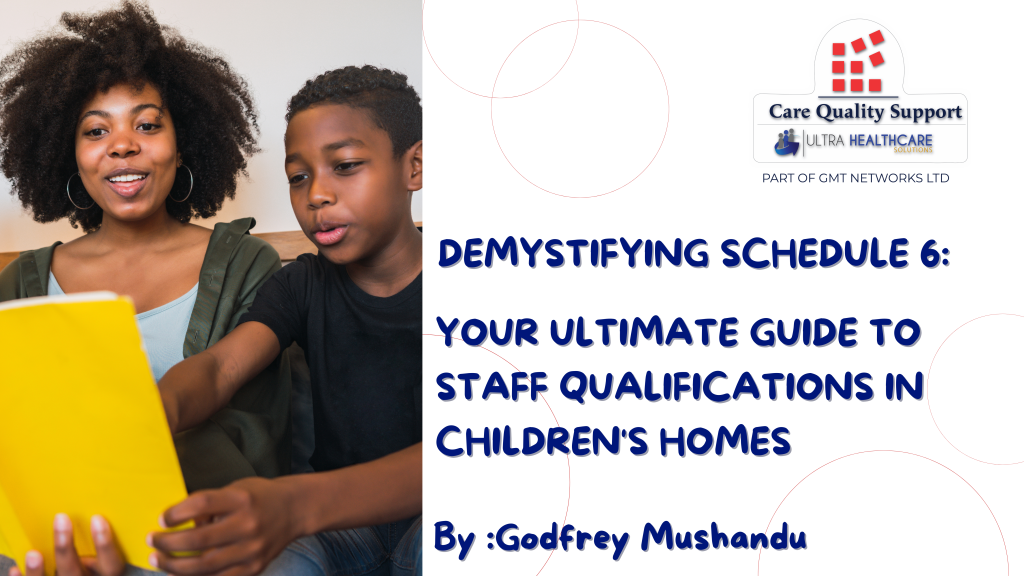
In the ever-evolving landscape of children’s social care, staying compliant with regulations isn’t just about ticking boxes, it’s about building homes where children truly thrive. At Care Quality Support, we specialise in empowering residential care providers with practical training, auditing tools, and expert guidance to navigate Ofsted inspections with confidence as well as schedule 6 staff qualifications in children’s homes which is our topic for this article.
Today, we’re zooming in on one of the most critical yet often misunderstood elements of the Children’s Homes (England) Regulations 2015: Schedule 6.
If you’ve ever scratched your head over Schedule 6 staff qualifications in children’s homes or wondered why your team’s training timelines feel like a puzzle, this blog is for you. Schedule 6 sets out the qualifications and experience requirements for managers and care staff in children’s homes. It’s not just a regulatory hoop, it’s the foundation for ensuring your team has the skills to safeguard, support, and inspire the young people in your care. Let’s break it down in detail, step by step, so you can turn compliance into a competitive edge.
Why Schedule 6 Matters: The Big Picture
Schedule 6 is divided into two key parts:
- Part 1: Focuses on the registered manager, the linchpin of your home’s leadership.
- Part 2: Outlines requirements for other staff involved in direct care.
These rules stem from a drive to professionalise the sector, ensuring everyone from the top down is equipped to meet the complex needs of children in residential settings. Non-compliance? It can lead to “Requires Improvement” or worse in Ofsted judgements, especially under Regulation 32 (Leadership and Management) and Regulation 28 (Protection of Children). But get it right, and you’re not only Ofsted-ready, you’re creating a culture of excellence.
Introduced in 2015, these requirements included transitional timelines to ease the shift (e.g., existing staff had until 2018 to qualify). As of 2025, with no major amendments, the focus is on ongoing enforcement and support for new hires. Pro tip: Use our Qualification Tracker Tool (available to subscribers) to map your team’s progress and spot gaps early.
Part 1: Qualifications and Experience for the Registered Manager
The registered manager is the heart of your children’s home, the person Ofsted holds accountable for day-to-day operations. Schedule 6, Part 1, mandates a blend of formal qualifications, relevant experience, and fitness checks to prove they’re up to the task. Here’s the detailed rundown:
1. Core Qualification Requirement
- The registered manager must hold (or be working towards) a Level 5 Diploma in Leadership for Health and Social Care (Children and Young People’s Residential Management pathway) or an equivalent qualification.
- Timeline: For new managers appointed after April 1, 2015, this must be achieved within 3 years of starting. Transitional provisions allowed existing managers until April 1, 2018, but by now, full compliance is expected.
- Equivalents: Recognised alternatives include the NVQ Level 5 in Leadership and Management for Residential Childcare or degrees in social work/childcare with relevant modules. Check the Regulated Qualifications Framework (RQF) for the latest approved list.
2. Experience Criteria
- At least 2 years of full-time experience in a senior role within health or social care settings for children or vulnerable adults. This could include positions like deputy manager, team lead, or specialist roles in fostering/adoption.
- Experience must demonstrate managerial oversight, such as supervising staff, managing risks, or leading safeguarding processes. Part-time roles count pro-rata (e.g., 4 years at half-time).
3. Fitness and Suitability Checks
- Enhanced DBS check (including barred list) and a full employment history verification.
- Proof of physical and mental fitness to perform duties, often via a health declaration.
- Ongoing monitoring: Annual appraisals and supervision to ensure continued suitability.
Compliance Tips from Care Quality Support
Failing Part 1 can trigger immediate Ofsted notifications and even deregistration. We’ve seen homes bounce back by enrolling managers in flexible online Diplomas our partners at endorsed providers offer bite-sized modules tailored to busy schedules. Remember, deferrals are possible for exceptional circumstances (e.g., long-term illness), but document everything meticulously.
Part 2: Qualifications and Experience for Other Staff
Not just the boss, every care worker touching a child’s life must meet standards. Part 2 ensures your frontline team is skilled, reducing risks like inadequate responses to trauma or poor behaviour support. It’s all about proportionality: higher roles need more quals.
1. Qualification Levels by Role
- Care Workers (Direct Care Roles): A Level 3 Diploma for the Children and Young People’s Workforce (Residential Childcare pathway) or equivalent. This covers essentials like child development, safeguarding, and health & safety.
- Timeline: New staff post-2015 had 2 years to qualify; legacy staff until 2017.
- Equivalents: NVQ Level 3 in Caring for Children and Young People, or Cache Level 3 Diploma in Child Care and Education.
- Senior/Deputy Roles: Often require Level 4 or 5, bridging to Part 1 standards.
- Support Staff (e.g., Cooks, Drivers): May need lower levels (e.g., Level 2) if not in direct care, but DBS checks are universal.
2. Experience Requirements
- At least 12 months in a relevant childcare or social care role for Level 3 qualifiers.
- For those without prior quals, a combination of induction training plus supervised practice can count towards experience.
3. Additional Safeguards
- All staff: Enhanced DBS, references, and health checks.
- Induction and Training: Mandatory programmes covering fire safety, first aid, and positive behaviour support before unsupervised work.
- Agency/Relief Staff: Must meet the same standards, no shortcuts for temps.
Compliance Tips from Care Quality Support
High staff turnover? Schedule 6 is your retention secret weapon, qualified teams feel valued and deliver better outcomes. Our Staff Development Workshops include mock assessments to prepare for inspections. Audit tip: Maintain a central “Quals Bible” with certificates, progress logs, and deferral evidence. Ofsted loves seeing child feedback on staff training too!
Common Pitfalls and How to Avoid Them
- Timeline Traps: Don’t assume “grandfathering”, post-2018 hires must hit deadlines or risk fines.
- Equivalence Errors: Always verify with Skills for Care; outdated quals won’t cut it.
- Documentation Drama: Keep records digital and accessible, inspectors request them on Day 1.
- 2025 Update Alert: While no changes yet, watch for post-election tweaks to training funding. We’ll cover it in our next webinar.
Wrapping Up: Elevate Your Home with Schedule 6 Mastery
Schedule 6 isn’t a burden, it’s your blueprint for a safer, more effective children’s home. By investing in qualifications, you’re not just complying; you’re fostering resilience in staff and hope in children. At Care Quality Support, we’re here to make it seamless: From bespoke qualification mapping to Ofsted prep packages, we’ve got your back.
Ready to level up? Download our free Schedule 6 Checklist or book a no-obligation audit today. What’s your biggest Schedule 6 challenge?
Drop a comment below, we read every one!
For the full legal text, head to legislation.gov.uk. Always consult the latest Ofsted guidance for interpretations.
Care Quality Support Supporting Excellence in Children’s Residential Care. Follow us for more insights!
By: Godfrey Mushandu /LinkedIn