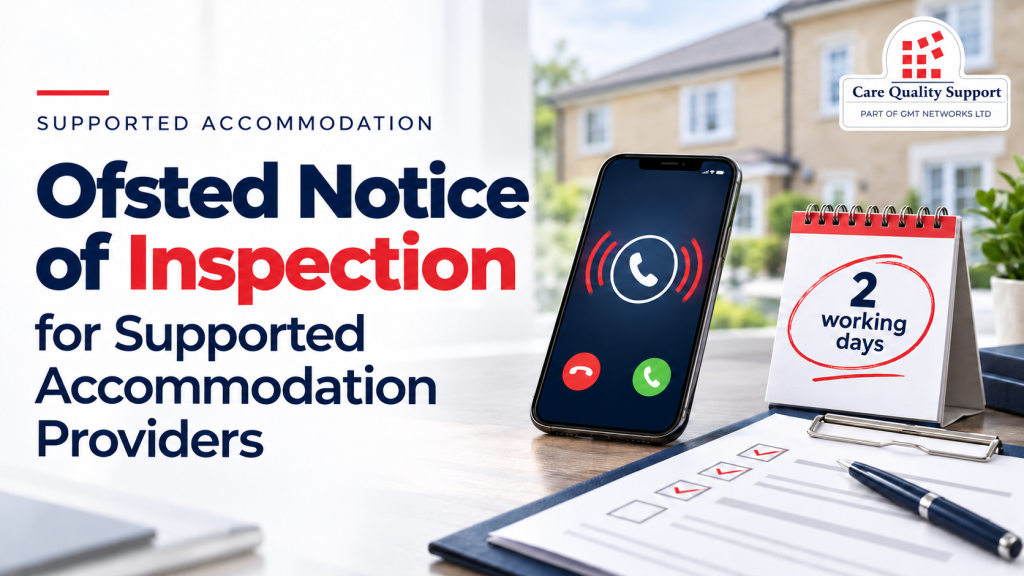
The Ofsted notice of inspection process is now clearer for supported accommodation providers. On 28 October 2026, Ofsted updated the Social Care Common Inspection Framework (SCCIF) for supported accommodation. Ofsted described the change as an update to clarify the inspection notification process. This article explains what the clarification means for providers supporting looked-after children and care leavers aged 16 and 17. It also sets out practical actions you can take within the next ten working days.
This guidance is for registered providers, Nominated Individuals and Registered Service Managers. Read it, share it with your leadership team and use it to test whether your service is ready from the moment Ofsted makes contact.
The clarification does not change the inspection framework
Ofsted has not changed what it inspects or how it evaluates supported accommodation services. The evaluation criteria, three-outcome model and inspection cycle remain in place. Instead, Ofsted has clarified how the notification process begins and who it expects to speak to on the first morning.
Although this may appear to be a small change, the first morning matters. A missed call, outdated contact details or uncertainty about who is responsible can reduce the time available to prepare. Therefore, providers should treat the update as a prompt to review their inspection arrangements rather than a reason to panic.
What has not changed about the Ofsted notice of inspection
The following points remain unchanged:
- Ofsted still gives two working days’ notice before inspectors arrive on site.
- The inspection starts when Ofsted announces it, not when inspectors arrive.
- Inspectors assess the registered provider or service, rather than each premises separately.
- The three-outcome model continues to apply.
- Ofsted usually reinspects services within approximately three years, 18 months or six months, depending on the previous outcome.
- Monitoring visits and inspections prompted by serious concerns may still take place without notice.
In short, the inspection framework has not changed. The update makes the start of the process clearer.
How the Ofsted notice of inspection process works
Providers should plan around the following sequence:
Ofsted makes the initial call. The Inspection Support Team usually telephones the provider by 9.30am. It then sends an email containing the practical arrangements, information requirements and the lead inspector’s contact details. The information request will include Annex A or Annex A1 for supported lodgings.
The Registered Service Manager is the expected contact. The Inspection Support Team arranges for the lead inspector to speak with the Registered Service Manager later that morning.
The Nominated Individual confirms an alternative where necessary. If the Registered Service Manager is unavailable, the Nominated Individual should confirm who will act as Ofsted’s first point of contact. Where the same person holds both roles, the provider should identify another appropriate contact in advance.
The inspection starts when Ofsted gives notice. Information gathered during the two-day notice period forms part of the inspection evidence. This may include conversations with leaders, young people and professionals, as well as information submitted through Annex A.
Inspectors make contact when they arrive. On arrival, inspectors notify the registered provider or Registered Service Manager. If neither is present, they speak to the person in charge.
As a result, providers should act as though the inspection has begun from the moment the telephone rings.
Why the first morning of an inspection matters
A smooth first morning gives leaders more time to focus on the inspection itself. By contrast, avoidable communication problems can interrupt the process before inspectors have reviewed the service’s evidence. Common risks include:
- Ofsted’s call going to a generic office line that no one monitors consistently.
- The Nominated Individual being unavailable and no deputy being identified.
- The Registered Service Manager having no agreed alternative contact.
These issues can shorten the effective notice period and may raise questions about governance arrangements. Clear contact and deputising procedures help the service respond calmly and professionally.
How to prepare for an Ofsted notice of inspection
Effective preparation is mainly about reliable people and systems. It should not depend on last-minute paperwork. The following four actions will strengthen your readiness.
Check that Ofsted can reach the right person
Confirm that Ofsted holds current telephone numbers and email addresses for the Registered Service Manager, Nominated Individual and registered provider. If any details have changed since registration, update them through the Ofsted portal.
As a matter of good practice, do not rely only on a generic reception number or an inbox that staff check infrequently. Use reliable contact routes that named leaders or their agreed deputies monitor during working hours.
Record your deputising arrangements
Identify who will take the initial call, lead the inspection and approve the Annex A response if the Registered Service Manager is unavailable. Record these arrangements in a short, dated inspection contact protocol. The Nominated Individual should approve the protocol, and everyone named in it should understand their role.
Where the Registered Service Manager and Nominated Individual are the same person, the provider should identify an alternative first point of contact. This reflects the clarified SCCIF notification process.
Keep Annex A ready for use
Annex A requests information that providers should already hold. This includes details about young people, placing authorities, staffing, safeguarding referrals, notifiable events and complaints.
As a practical readiness measure, maintain a working version and review it regularly. A monthly management check can help keep the information current. You can also consider its accuracy when completing the six-monthly quality of support review under regulation 32. On inspection day, the aim should be to verify and update existing information rather than assemble it from the beginning.
Prepare people as well as documents
Use the two working days to inform young people, staff, placing social workers and supported lodgings hosts that inspectors are coming. Explain what to expect in a calm and accessible way.
Inspectors want to hear directly from young people. Their confidence should come from their everyday experience of the service, not last-minute coaching. A strong culture enables young people to speak openly about the support they receive.
Seven actions to complete within ten working days
Complete these actions and record the results in your governance log:
| Action | What to do | Suggested owner |
| Verify your contact details | Check what Ofsted holds for the Registered Service Manager, Nominated Individual and registered provider. Correct any errors through the Ofsted portal. | Nominated Individual |
| Issue an inspection contact protocol | Name the first contact, deputy and escalation route if neither person can be reached when Ofsted calls. | Nominated Individual and Registered Service Manager |
| Test the manager’s direct contact route | Confirm that the telephone and email arrangements are monitored during working hours, including during planned leave. Check voicemail arrangements as well. | Registered Service Manager |
| Refresh the Annex A working document | Review the current information and diarise regular checks. | Registered Service Manager |
| Brief staff and supported lodgings hosts | Explain the notification process and their role during the notice period. | Registered Service Manager |
| Run a desktop notification drill | Simulate the morning call. Test whether the right person can be reached and whether the service can prepare Annex A promptly. | Nominated Individual |
| Read the revised SCCIF section | Review the notice of inspection section in full and retain a dated record of the review. | Registered Service Manager |
Give each action a completion date and review progress at the next leadership meeting.
Turn the Ofsted update into inspection evidence
Inspectors may ask how leaders monitor and respond to regulatory change. This update gives providers an opportunity to demonstrate that process. Retain a dated record of your SCCIF review, the resulting contact protocol and the outcome of any notification drill.
This evidence may support the leadership and management evaluation criteria. More importantly, it shows that leaders translate regulatory information into practical improvements.
The relevant legal framework remains the Supported Accommodation (England) Regulations 2023. This includes regulation 27 on notifications and regulation 32 on the six-monthly quality of support review. Read the regulations alongside the SCCIF for supported accommodation and the Department for Education’s Guide to the Supported Accommodation Regulations, including the Quality Standards.
How Care Quality Support can help
Care Quality Support helps supported accommodation providers prepare for inspection and present their evidence clearly. Support available in response to this update includes:
- An inspection contact protocol template and notification drill pack tailored to your service structure.
- An Annex A readiness review and mock inspection against the SCCIF for supported accommodation.
- A briefing for Registered Service Managers and Nominated Individuals on the revised notification process.
Visit carequalitysupport.co.uk to find out more.
Final thoughts on the Ofsted notice of inspection
The Ofsted notice of inspection update does not change what good service delivery looks like. However, it places greater attention on how providers manage the first morning. Check your contact details, record your deputising arrangements, keep Annex A ready and prepare your people. Then test the process through a desktop drill.
Finally, read Ofsted’s revised notice of inspection section in full. The SCCIF for supported accommodation was last updated on 28 October 2026 and is available at: https://www.gov.uk/government/publications/social-care-common-inspection-framework-sccif-supported-accommodation