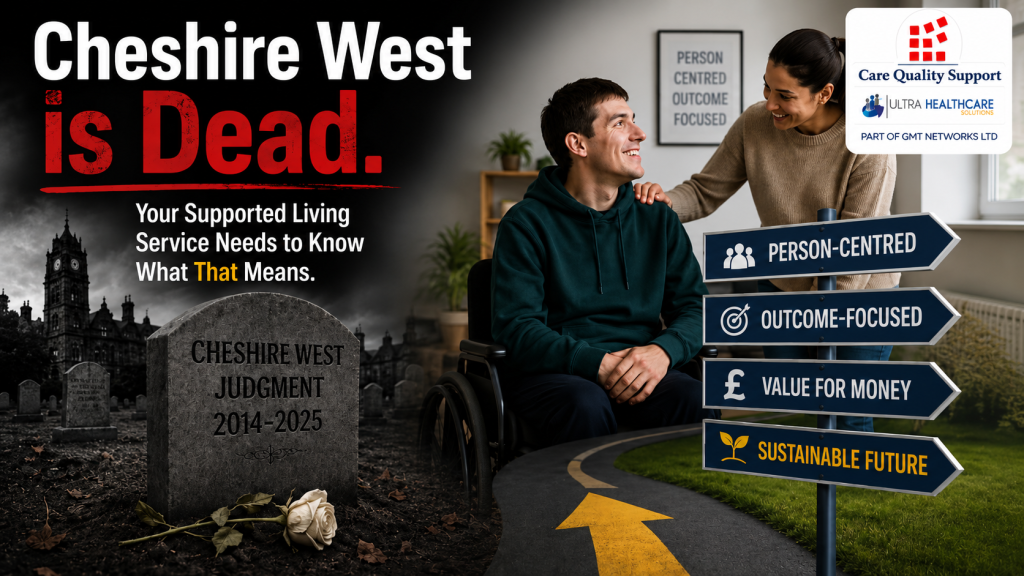
On 2 June 2026, the UK Supreme Court delivered a judgment that fundamentally reshapes how we assess deprivation of liberty in community care settings. Many experts are already describing the decision as “Cheshire West is Dead” because it marks the end of the legal framework established by the landmark 2014 judgment. If you work in domiciliary care, supported living, children’s homes, or any service supporting adults with capacity concerns, this is not optional reading.
Why Cheshire West is dead
The Supreme Court unanimously overruled P v Cheshire West and Chester Council — a 2014 landmark decision that has defined deprivation of liberty law for the past 12 years. They did not do this lightly. They did it because Cheshire West got it wrong.
Under Cheshire West, if a service user lacked mental capacity to consent to their care arrangements AND was subject to continuous supervision and control AND was not free to leave, they were automatically deprived of their liberty. Full stop. No exceptions. No nuance. The courts called it the “acid test.”
The result? DoLS (Deprivation of Liberty Safeguards) applications in England and Wales exploded from 13,700 per year before Cheshire West to 332,455 by 2023/24. There is now a backlog of 123,790 cases. An estimated 400,000+ people across the UK are classified as deprived of liberty under this framework.
The system broke under its own weight. And the Supreme Court said: this is wrong. That is precisely why many commentators now say, “Cheshire West is Dead.”
What changes now that Cheshire West is dead
The new legal test is multifactorial. No single factor decides the outcome.
Instead of asking “Is the person subject to continuous supervision and not free to leave?”, you now ask:
1) What is the type of care arrangement? (Own home? Supported living? Care home? Hospital?)
2) Consider the effects of those restrictions on this particular person.
3) What are the effects of those restrictions on this particular person?
4) What is the manner of implementation? (Supportive? Coercive? Punitive?)
5) Is the placement relatively normal given the person’s needs?
6) What is the purpose of the restrictive measures? (Care and safety? Or control?)
Most crucially: Can the person express their wishes and feelings about their situation?
And do those wishes suggest acceptance or resistance?
This last point is revolutionary.
The Game-Changer: Valid consent without legal capacity
Here is what the Supreme Court ruled:
A person who lacks legal mental capacity to decide on their care arrangements can nonetheless give “valid consent” to those arrangements if they have basic awareness of their situation and can express their view about it.
Let that sink in.
For 12 years, the law said: no capacity = no consent = deprivation of liberty. Automatic.
Now the law says: lack of capacity does not automatically mean lack of consent.
If the person is conscious of their environment, understands (in basic terms) what their care arrangement is, and can express whether they are content with it or unhappy, their wishes matter. Their consent matters.
This is not a free pass for providers to ignore safeguards. But it is a recognition that a service user living happily in their own home or a supported living placement, who actively expresses that they want to be there and are content with their support, should not be treated as unlawfully detained simply because they lack the legal capacity to have “consented” in the formal sense.
What this means in practice
Your supported living service user who has a learning disability, lacks legal capacity, but loves their home, has built relationships with their housemates, engages positively with their support workers, and, when asked, indicates they are happy there: they may no longer be classified as deprived of liberty.
A domiciliary care client with early dementia, living in their own home with daily support, who recognises their care worker and seems content: same logic applies.
Your children’s home resident who communicates through Makaton, cannot make formal decisions about their placement, but clearly expresses (through their communication method) that they want to stay: their view now carries weight in the legal assessment.
But, and this is critical, if serious doubt exists about whether the person genuinely consents or is simply acquiescing out of fear, habit, or inability to object: the safeguards apply. No inference of consent should be drawn.
What you must do now that “Cheshire West is dead”
- Audit your current assessments. If you have service users you’ve classified as “deprived of liberty” under the Cheshire West acid test, you need to reassess them using the new multifactorial framework. Some may no longer meet the threshold.
- Review your care plans and documentation. Are you evidencing wishes and feelings? Are you assessing the actual context of the person’s situation, not just ticking a box that says “supervised and confined”?
- Train your staff. Your registered manager, care coordinators, and support workers need to understand that the legal test has changed. The old binary (deprived/not deprived) is gone. It is now contextual and nuanced.
- Update your policies. Your safeguarding, restrictive practice, consent, and care planning policies all need to reflect the new framework.
- Prepare for CQC inspection. The Care Quality Commission will be applying this judgment to its inspection framework. Inspectors will be asking: “How have you assessed whether this person is deprived of liberty? What evidence do you have of their wishes and feelings? How have you balanced their rights to autonomy with their need for protection?”
The Warning
If Cheshire West is Dead, this ruling applies immediately. There is no transition period. If you are still operating under Cheshire West assumptions, you are out of step with the law.
That said, this is not a license to cut corners on safeguarding. The Supreme Court was emphatic: vulnerable people with impaired capacity still need protection. The difference is that protection is now tailored to their actual situation and their expressed preferences — not imposed by a one-size-fits-all legal formula.
The opportunity
For services run well, with genuine person-centred practice, real evidence of what service users want, and clear documentation of the multifactorial assessment, this ruling is liberating. It recognises that good care is not oppressive confinement, even when the person cannot formally consent to it.
For services run poorly, where control masquerades as care, where service users’ voices are not heard, where restrictive practices are normalised, this ruling exposes the gap between legal theory and lived reality. CQC will be looking for that gap.
Where to go next
Read the full judgment if you have the technical capacity. It is dense but thorough: A Reference by the Attorney General for Northern Ireland [2026] UKSC 16.
If you need practical guidance tailored to your service model, whether that is supported living, domiciliary care, children’s homes, or any other setting, speak to a compliance specialist who understands both the judgment and the operational reality of care delivery.
This is not a problem to leave for next month. It is a compliance priority for this week.
Cheshire West is dead, what is your take?
Are your teams already reassessing under the new framework?
Drop your thoughts in the comments, I am keen to hear how this is landing across the sector.