Neither CQC nor Ofsted sets a blanket rule that care plans must be written in first person (“I want…”) or third person (“X wants…”). What they do consistently require is that plans and records demonstrate the person’s (or child’s) needs, preferences, and involvement in planning and review, and that support is clearly described and deliverable in practice. Regulation 9: Person Centred Care-The intention of this regulation is to make sure that people using a service have care or treatment that is personalised specifically for them. This regulation describes the action that providers must take to make sure that each person receives appropriate person-centred care and treatment that is based on an assessment of their needs and preferences.
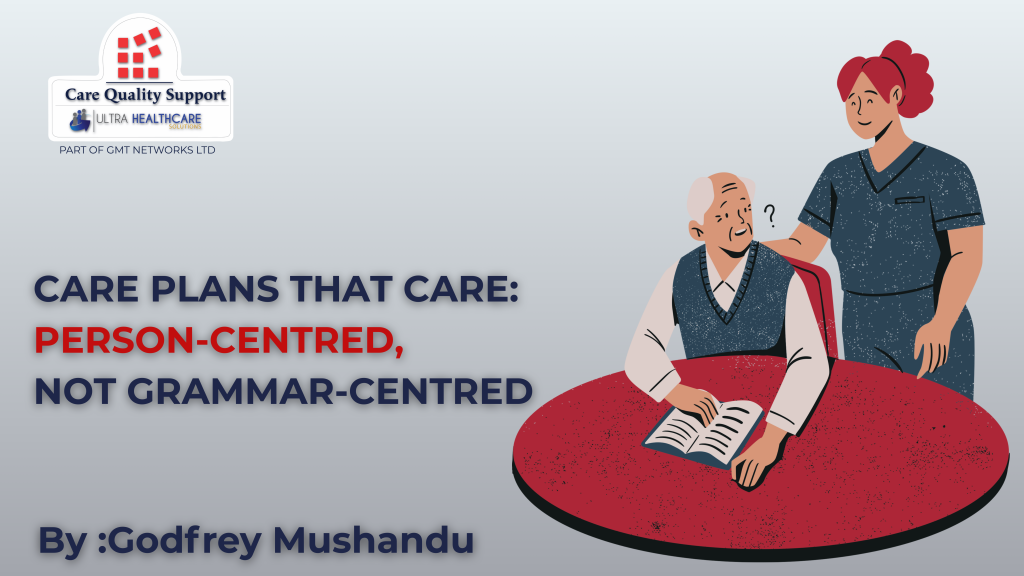
In UK health and social care, the real question is not “first or third person?”, but “does this care plan clearly show the person’s wishes, feelings, needs and outcomes – and how we will meet them in practice?”. This is what CQC and Ofsted ultimately test against their regulatory frameworks, not grammatical purity.
CQC: Regulation 9 and person‑centred records
For adult services, the legal anchor is Regulation 9 (Person‑centred care) of the Health and Social Care Act 2008 (Regulated Activities) Regulations 2014. It requires providers to design and deliver care “so as to ensure” it meets people’s needs and preferences, involves them in decisions, and enables them to be in control as far as reasonably practicable.
CQC’s Single Assessment Framework expands this under the “Person‑centred care” quality statement, asking whether people are true partners in planning and reviewing their care and whether records reflect what matters to them in a way they understand. There is no requirement that care plans are all first person or all third person; what inspectors want to see is co‑production, accessibility and a clear golden thread from outcomes to day‑to‑day support.
A pragmatic approach is therefore:
- Use first person (“I…”) for “About me”, “What matters to me”, routines and outcomes where the person has contributed to the wording – this visibly evidences involvement and ownership.
- Use third person for clinical instructions, risk management, safeguarding and professional analysis, where clear, directive language to staff is essential.
This blended model is fully consistent with Regulation 9 and national personalised care and support planning guidance.
What CQC expects to see in care planning
CQC’s Regulation 9 is explicit that care must be person-centred, based on an assessment of needs and preferences, and that the person (or someone lawfully acting on their behalf) must be involved in planning, management and review.
CQC’s single assessment framework also frames “person-centred care” through first-person outcome statements (for example, “I am in control of planning my care and support…”). That’s not a command to write every plan in first person, but it is a clear signal of the perspective CQC is testing: does the plan reflect what matters to the person, and does it show choice, control and coordination.
What this means for “I” vs “they” in adult care plans
-
First person is often best for preferences, routines, goals, anxieties, and what good support feels like to the person.
-
Third person is often best for clinical facts, risk assessment rationale, medication directions, safeguarding decisions, and Mental Capacity Act recording where the person cannot make a specific decision.
CQC also links person-centred planning to consent and capacity considerations, so you need language that stays accurate when capacity is fluctuating or absent.
Ofsted – Children’s homes: Regulations 7 and 14
For children’s homes, the statutory framework is the Children’s Homes (England) Regulations 2015, supported by the statutory “Guide to the children’s homes regulations, including the quality standards”.
Two regulations are especially relevant to how you write and present care plans:
- Regulation 7 – The children’s views, wishes and feelings standard: children must receive care from staff who develop positive relationships, engage with them and “take their views, wishes and feelings into account in relation to matters affecting the children’s care and welfare and their lives”.
Staff must help each child to express their views, prepare for reviews and understand how their views have been considered.
- Regulation 14 – The care planning standard: children must receive effectively planned care and have positive experiences of arriving at and moving on from the home, and the registered person must ensure each child’s “relevant plans” are followed.
The associated guidance stresses that staff should help each child to access and contribute to the records kept about them.
Nothing in these regulations dictates first vs third person, but the combination of Reg 7 and Reg 14 makes one thing crystal clear: children’s wishes, feelings and participation in planning must be explicitly visible in records.
That is where the person‑centred vs grammar‑centred decision comes in:
- First person (“I feel safest when…”, “Things that help me when I am angry…”) is a powerful way to show Reg 7 in practice and make it obvious that the child has been heard.
- Third person remains entirely appropriate for behaviour support protocols, missing‑from‑home plans and safeguarding arrangements, where Ofsted expects precise instructions to staff under the care planning standard.
Used intelligently, mixed‑person care plans therefore become direct evidence of regulatory compliance rather than a stylistic quirk.
Ofsted – Supported accommodation: 2023 Regulations and quality standards
For supported accommodation for 16–17‑year‑olds, the Supported Accommodation (England) Regulations 2023 and the accompanying “Guide to the supported accommodation regulations including quality standards” establish the legal and practice framework, with Ofsted as the regulator.
Providers must meet four quality standards: the leadership and management standard, the protection standard, the accommodation standard and the support standard.
The Guide sets clear expectations that:
- Each young person must have a plan which sets out how the service will support their assessed needs and aspirations, including managing day‑to‑day risks in agreement with the young person and their accommodating authority.
- Young people should be involved in developing and reviewing their plans and in decision‑making about their lives.
Again, the legislation does not prescribe grammatical person, but it does require that young people’s wishes and feelings about where they live, their future and the support they receive are understood and recorded.
Using first person for “My goals”, “My education, training and employment plans”, “How staff can best support me” is therefore a very inspection‑friendly way to demonstrate you are meeting the support standard and the wider participation expectations.
Third person is still advisable for formal risk plans and safeguarding content that must be crystal clear for staff.
What Ofsted expects to see in care planning and records
For children’s homes, the regulatory framework and accompanying guide emphasise that children’s views, wishes and feelings must be taken into account, and that staff should help children contribute to reviews of their relevant plans.
The children’s homes guide also sets out the care planning standard, including expectations that children receive effectively planned care and that staff help each child access and contribute to records kept about them.
More broadly, Ofsted’s published learning about the “voice of the child” highlights historic failures where children were not asked about their views and feelings and their voice was not heard sufficiently. That context is why plans and records that clearly evidence the child’s perspective (in an age-appropriate way) matter so much.
What this means for “I” vs “they” in children’s plans
-
First person (or direct quotes) helps evidence voice: it shows what the child is saying, wants, fears, and how they understand what is happening.
-
Third person is still essential for safeguarding analysis, professional observations, and decisions that balance wishes against best interests.
A practical, regulator-friendly way to write care plans
Use first person for the “voice” sections
These sections work well in first person because they read as outcomes and preferences, and they make it harder for plans to become generic:
-
What matters to me
-
How I like to be supported
-
My daily routine
-
My communication
-
My choices and goals
-
What helps when I’m worried or distressed
This aligns with CQC’s focus on needs, preferences, and involvement.
Use third person for professional and operational clarity
These sections are usually safer in third person because they must be unambiguous, auditable, and clinically or legally precise:
-
Risk assessments and risk management rationale
-
Medication and treatment instructions
-
Safeguarding actions and thresholds
-
Mental Capacity Act documentation and best-interests decisions
-
Contingency planning (who does what, when, escalation routes)
This approach supports a clear line from assessment to planned support.
Bridge the two with clear attribution
Where first person could mislead (for example, if the person lacks capacity, or the child hasn’t directly said something), keep the “voice” but attribute it accurately:
-
“I feel calmer when…” (directly expressed)
-
“Staff observed that I appeared calmer when…” (observation)
-
“My advocate/family member told staff that I usually prefer…” (third-party account)
That prevents the common compliance pitfall of writing “I want…” when it is actually an assumption.
Common pitfalls CQC and Ofsted see (and how wording contributes)
-
Generic first-person templates that could belong to anyone (“I like my privacy respected”) without specific detail. CQC expects care to reflect individual preferences and assessment.
-
Third-person-only plans that never evidence involvement, choice, or the person’s perspective, undermining person-centred care.
-
False certainty: writing in first person to imply agreement where the person/child has not contributed, or where capacity/understanding is not evidenced.
-
Voice without action: lovely “I statements” but no clear staff direction, meaning care delivery becomes inconsistent (and hard to assure).
A simple rule you can adopt in your service
Use first person for anything that should answer: “What is life like for this person, and what matters to them?”
Use third person for anything that should answer: “What must staff do, how will risk be managed, and what is the evidence for decisions?”
That combination is usually the most defensible way to meet both regulators’ intent: person-centred planning with demonstrable voice, backed by clear, deliverable instructions and decision-making
Pulling it together: a regulation‑aligned documentation policy
If you want your approach to come across as both professional and authoritative to CQC and Ofsted, you can explicitly frame your documentation policy like this:
Legal and regulatory anchors
- Adult services: Regulation 9 (Person‑centred care), Health and Social Care Act 2008 (Regulated Activities) Regulations 2014, and CQC’s Single Assessment Framework “Person‑centred care” quality statement.
- Children’s homes: Children’s Homes (England) Regulations 2015, particularly Regulation 7 (Children’s views, wishes and feelings standard) and Regulation 14 (Care planning standard), alongside the statutory Guide.
- Supported accommodation: Supported Accommodation (England) Regulations 2023 and the Guide to the supported accommodation regulations including quality standards (with Ofsted’s four quality standards).
House style for plans
- Plans should be written in the person’s or child’s own voice wherever practicable – typically first person for wishes, feelings, preferences and outcomes, directly supporting CQC’s person‑centred expectations, Children’s Homes Regulation 7 and the participation requirements in supported accommodation guidance.
- Third person may (and often should) be used for professional judgements, risk and safeguarding plans, clinical directions and behaviour support strategies, to ensure clarity and reflect the provider’s duties under Regulation 14 (care planning) and the protection and support standards in supported accommodation.
Audit and governance
- Your care plan audits should explicitly check: “Is the person’s/child’s/young person’s voice clearly visible and traceable to decisions (Reg 9 / Reg 7 / supported accommodation standards)?” and “Is there a clear line from regulatory requirements through to the wording and format of the plan?”.
Framed this way, first vs third person stops being a stylistic debate and becomes a conscious, regulation‑aligned strategy for evidencing person‑centred and child‑centred practice in line with CQC, Ofsted and the Supported Accommodation Regulations.
If you lead or manage CQC or Ofsted regulated services, this is the moment to review your care and support planning templates, policies and audits through a genuinely person‑centred lens. Ask yourself: does our documentation prove that people’s and children’s wishes, feelings and outcomes drive how we work – or are we still prioritising tidy grammar over lived experience?
If you would like support to align your care planning approach with Regulation 9, the Children’s Homes Regulations 2015 and the Supported Accommodation (England) Regulations 2023 – and to evidence this confidently at inspection – connect with me to explore how I can help.
Comment below or send us a message if you would like:
- A care‑planning policy and template review against CQC, Ofsted and Supported Accommodation requirements.
- Training for your teams on writing inspection‑ready, person‑centred plans that still meet clinical and safeguarding expectations.
- Independent audits of your documentation and governance, with practical recommendations.
Let’s make care planning truly person‑centred and let the grammar serve the person, not the other way round.
Please do not hesitate to contact us for further clarification.
Godfrey Mushandu
Managing Director
Care Quality Support and Ultra Healthcare
Registered Address: 20-22, Wenlock Road, London, N1 7GU, England.
Operational Office: Astral Towers, 4th Floor, Betts Way Crawley, RH10 9XA
Email: godfrey@carequalitysupport.co.uk
Web 1: https://www.carequalitysupport.co.uk/
Web 2: https://www.ultrahealthcare.co.uk
Phone: 020 8064 2464 WhatsApp: +447737144708
| 📞 Admin Contact for Additional Support: Email: admin@carequalitysupport.co.uk Phone: 02080642464 Website: Care Quality Support WhatsApp: +447737144708 |